Repiping a Los Angeles house without surprises
To repipe a house in Los Angeles, expect a licensed plumber, an LADBS permit and inspection, a choice between copper and PEX, and some opened walls. The bid should spell out each of those in writing.
From the Plumbing Across L.A. desk. Updated .
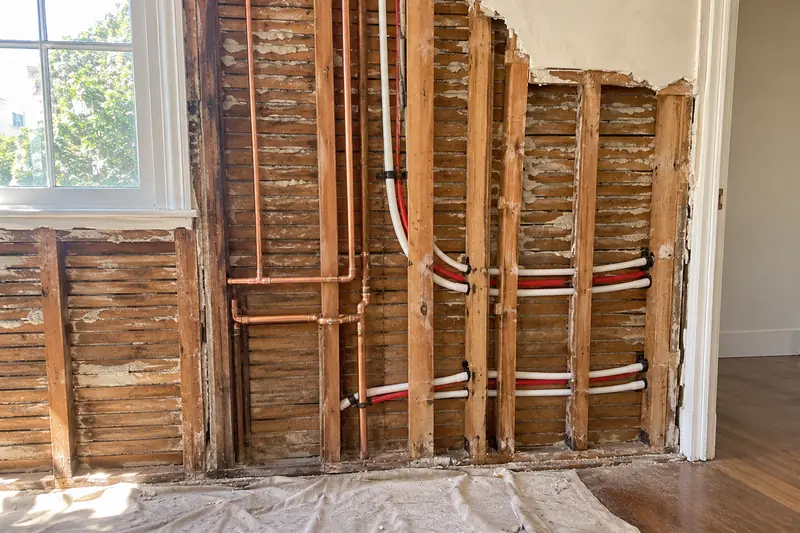
A repipe replaces the water supply pipes in the house. It does not normally touch the drains or the sewer lateral, which are separate jobs covered in cast iron and clay drains. Before you decide, read how to recognize galvanized pipe, because that is what many L.A. repipes replace.
This paper does not publish repipe prices. We have no sourced number, and the range depends on the house. The way to find your price is several written bids for the same scope.
Does repiping a house in Los Angeles need a permit?
Plan on it in the City of Los Angeles. LADBS's permit list has a domestic water re-pipe item, and its express permit bulletin lists some plumbing work that goes without plan review, such as underground water pipes of the same size and material. We could not confirm that a full interior repipe counts as express. Ask LADBS, and apply through PermitLA.
A contractor certified under the City's Certified Licensed Contractor program can do domestic water piping under 50 feet without a separate permit. A whole-house repipe is usually longer than that, so ask. The permits page has the wider picture. Separate cities such as Pasadena, Glendale and Burbank run their own departments.
Two side effects are worth asking about at the start. California law says that on alterations to single-family property, the permit applicant replaces noncompliant fixtures as a condition of final approval; read low-flow fixtures at sale. In the City of Los Angeles, a project with gas and a valuation over $10,000 can also call for a seismic gas valve. Ask LADBS whether your scope triggers that.
Should a Los Angeles repipe use copper or PEX?
Either can be a sound choice, depending on the house. Copper is long established. PEX is flexible plastic tubing that can snake through tight spaces with fewer joints. Its road in California was bumpy: a trade report says the state added it in 2009, repealed it under a court order and approved it again in 2010. Ask your plumber and LADBS what the current code allows for your job.
| Question | Copper | PEX |
|---|---|---|
| How are joints made? | Usually soldered or pressed; ask which, and confirm lead-free solder | Crimped or expanded fittings; ask which system and its warranty |
| How much wall gets opened? | Rigid runs may need more access | Flexible runs may need fewer openings, not none |
| What about exposed runs? | Ask about protection and support | Ask what the maker says about sunlight and heat |
| What about the water? | Ask how your water's hardness affects the choice | Ask the same, and about fittings |
Federal law limits lead in pipe, fittings and fixtures sold as "lead-free," and EPA has the details. Ask for lead-free materials in writing either way. Your water's hardness varies by neighborhood, which is worth raising too.
How do plaster walls and crawlspaces change a repipe?
They change how much gets opened, who patches it and how long it takes. Older houses often have plaster and lath rather than drywall, and a raised floor can give access from below. Many postwar houses sit on slabs, where the route usually shifts into walls or the attic; read about slab leaks in Valley ranch houses.
Paint matters too. EPA's Renovation, Repair and Painting rule requires anyone paid to disturb painted surfaces in homes built before 1978 to be certified in lead-safe work practices. If your house is that old, ask for the firm's certification. Other older materials may need a separate look, so ask before walls open.
How do you compare repipe bids without a price guide?
Make the scope identical, then compare. Ask each plumber to answer the same list in writing:
- License number and classification, which you then check at CSLB.
- Who pulls the permit, and that the job gets inspected. CSLB says the contract should state who gets permits.
- Which pipes stay: the line from the meter, the branch lines, the stubs under sinks, the hose faucets.
- Materials, by type and size, including valves.
- Wall and ceiling openings, who patches them and to what finish.
- How many days the water will be off, and what you'll have in the meantime.
- A payment schedule that stays within the down payment limit: not more than $1,000 or 10 percent, whichever is less.
A bid that leaves these out may not be cheaper. It may just be a smaller job.
What this means by age of house
- Before 1930Expect plaster, possible raised floors and a history of partial repairs. Ask how old and new sections join. See before 1930.
- 1930s–1940sGalvanized is often part of the mix, along with earlier repairs. Bungalows may offer crawlspace access. See the 1930s and 1940s.
- 1950s–1960sSlab foundations are common, so routes often change. Ask whether the old lines are abandoned or removed.
- 1970s and newerA full repipe is less often the first answer. Find the cause first, since one leak doesn't always mean the whole system has failed.
Questions that come up
Can we stay in the house during a repipe?
Many people do, but ask how long water will be off each day and how dust and open walls get handled. It depends on the house and the crew.
Should the old pipes come out?
Often they are left in place and disconnected when removal would mean opening more wall. Ask what each bid does and put it in writing.
Does an owner-builder permit let you hire someone cheap?
Owner-builder permits have conditions, and the responsibility stays with you. Read the LADBS owner-builder document before you agree to that arrangement.
Does a repipe include the main line from the meter?
Not automatically. Ask. The line from the meter to the house is a separate item in many bids.
Who handles this
What this was checked against
- Domestic re-pipe and same-size underground pipe on the permit lists: LADBS permit pages
- Fixtures on alterations, Civil Code 1101.4: Public.Law state code pages
- Payment schedules and permits in a contract: State contractors board
- Renovation, Repair and Painting program: U.S. EPA lead pages
- Lead-free limits for pipe and fittings: U.S. EPA water pages
- California PEX history, trade report: Contractor magazine
Sources read in November 2026. Rules and prices change: check the agency before you act.