Cast iron and clay: the drains under an older L.A. house
Cast iron drain pipe in an old house usually rusts and cracks, while clay sewer pipe tends to fail at its joints. A camera can show which you have and where it is failing. Repairs are licensed work.
From the Plumbing Across L.A. desk. Updated .
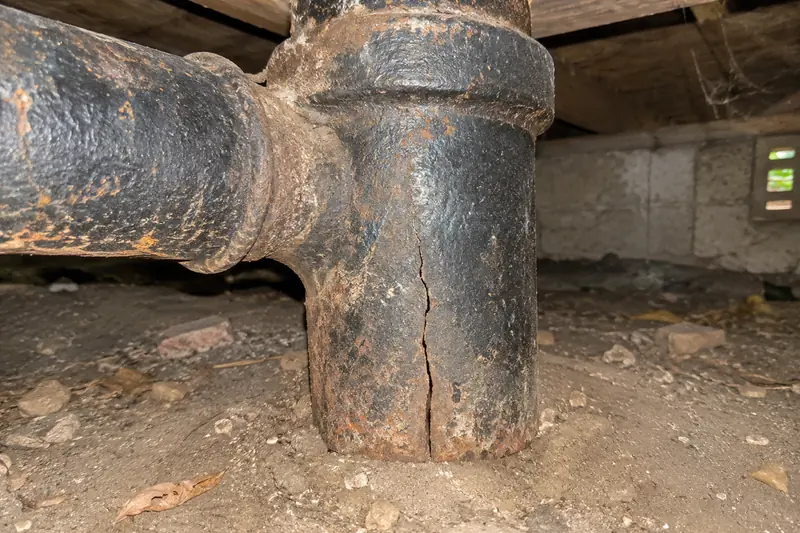
Nobody can tell you what is under your house from its year alone. A 1924 bungalow may still have its original drains, or it may have been rebuilt twice. The age is a clue, and the before-1930 page explains how far to trust it.
What follows is the usual layout. Treat every piece of it as a guess until someone has looked inside the pipe.
What does a cast iron drain pipe in an old house actually do?
It carries waste from your fixtures down and out to the building sewer. Pasadena's public works department describes the pattern plainly: interior pipes converge into one pipe just outside the house. In many older houses that interior run is cast iron, and the pipe beyond it is often clay.
The City of Los Angeles splits the outside run in two. The building's sewer pipe reaches the property line, then a house connection carries sewage to the main, usually in the middle of the street. Both ends are yours to maintain, as our lateral story sets out.
| Piece | Common old material | Where it runs |
|---|---|---|
| Stacks and branch drains | Cast iron, sometimes with later plastic repairs | Walls, floors, crawlspace |
| Building sewer | Clay or cast iron | Yard, to the property line |
| House connection | Often clay | Parkway and street, to the main |
How do clay sewer pipes fail?
Mostly at the joints. San Luis Obispo's utilities department, which is not an L.A. agency, flags clay joints as vulnerable to roots and groundwater getting in, and calls the pipe itself brittle.
A Riverside public works brochure describes the sequence: joints fail or the pipe cracks and leaks, and nearby roots go after the moist soil. That is why a street of old clay and big trees produces the story told in ficus and jacaranda roots.
Sections can also shift out of line. The City's S-Permit handout lists what video can reveal, and offset joints and collapsed sections are both on it alongside roots and cracks.
How does old cast iron fail?
Cast iron is metal, so it can rust, and a rusted wall gets thin. Trade inspectors commonly report rough interiors, cracks along the bottom of horizontal runs and leaks at old joints, though this paper found no L.A. agency that publishes a lifespan for it. Treat any confident number of years with suspicion.
Failure is usually gradual and local. One bad section does not prove the whole system is finished, and one clean section does not prove the rest is sound.
What are the signs a drain is in trouble?
The useful sign is a pattern, not one slow sink. Pasadena notes that blockages can sit in a fixture, in interior pipes or in the house sewer, that roots and grease are the common causes, and that a problem in the city's own line is very rare and tends to affect the whole neighborhood.
- One fixture slow: likely that fixture or its branch.
- Several fixtures slow together, or a toilet bubbling when the washer drains: suspect a shared line.
- Sewage at a floor drain or tub: quit running water and phone a licensed plumber.
- A sewage smell in a crawlspace: stay out of it and let a plumber look.
If sewage has backed up, do not open a cleanout to relieve it, because the contents can come out under pressure and all at once. Stay out of the water. Pasadena's advice on sewage is blunt: keep people and pets away, because untreated wastewater carries high levels of viruses and bacteria. Pasadena also says it is illegal to open or enter a manhole there for any reason, and nobody else should try it either.
What this means by age of house
- Before 1930Original cast iron and clay are plausible, and so are decades of patches in mixed materials. Expect surprises at each transition.
- 1930s–1940sOften the same pairing, frequently with clay out to the street under trees planted when the house was new.
- 1950s–1960sCast iron often remains common indoors, and slab houses may run it under the floor, which makes a repair much harder to reach.
- 1970s and newerPlastic drains become more common, but an older lateral may still connect them to the street. Ask what was replaced.
Why is drain repair licensed work?
Because of what is in the pipe and where it runs. CSLB's C-36 page names the license classes for building sewers, and a handyperson is limited to $1,000 total with no permit work, which rules out most drain jobs. Start with our notes on hiring a C-36.
Work outside the property line adds another layer. Inside the City of Los Angeles, fixing a damaged house connection takes an S-Permit, and sewer digging in the public right-of-way is limited to contractors on the bonded list. Check what LADBS permits cover for the inside of the property line.
Do not cut or sand old pipe yourself. Its age and contents are unknown, and old joints and coatings may contain materials you do not want in the air. Trenching is also not a homeowner job: a yard or parkway can hide gas, water and electric lines.
What should you ask for before anyone cuts?
Ask for video first, and keep the file. Sewer camera inspections give everyone the same picture to argue about, and City of Los Angeles ratepayers may have a rebate to help.
- Ask what material the pipe is at each point on the video, and how the plumber can tell.
- Ask where each defect sits, measured from the access point.
- Ask whether the fix is a section or the whole run, and why.
- Ask who pulls the permit, and get the license number in writing.
Who handles this
- CSLBContractor license lookup
- LADBSPrivate-side plumbing permits and inspection
- Bureau of Engineering, City of L.A.Connection permits and the bonded list
- LA SanitationVideo and repair rebates, and City mains
Questions that come up
Without video, how do you tell cast iron from clay?
Sometimes by sight, where the pipe is exposed in a crawlspace. Underground runs usually need video, and even then the plumber should say how sure they are.
Should a sound old drain get regular cleaning?
Pasadena's advice is a yearly cleaning and inspection. Ask your plumber whether the video supports that schedule for your line.
Must every old drain be replaced together?
Not necessarily. The video may show one bad section. Ask for the reasoning behind a whole-house recommendation, and get a second reading if the answer is thin.
Who inspects a repaired drain?
Work under a permit gets an inspection, and repairing a house connection in the City of Los Angeles involves a City inspector. Keep the signed final, since the rebate program asks for it.
What this was checked against
- Blockages, roots and manholes in a house sewer: City of Pasadena Public Works
- CCTV findings in reconnection cases: Palisades recovery site
- Pipe material guidance for laterals: City of San Luis Obispo Utilities
- Failed joints and root entry: Riverside city brochure
Sources read in November 2026. Rules and prices change: check the agency before you act.