Ficus, jacaranda and your sewer line
Tree roots in a sewer line in Los Angeles are the property owner's bill, even when the tree is the City's. Pruning a street tree's roots takes a no-fee permit from StreetsLA Urban Forestry Division first.
From the Plumbing Across L.A. desk. Updated .
The ficus has a reputation here, and some of it is earned. A 2008 Boston Globe report quoted the city's assistant chief forester putting Ficus microcarpa at about 9 percent of the trees along Los Angeles streets, and an arborist saying its roots can reach as far as 90 feet from the trunk. That figure is old and came from one arborist, so read it as a sense of scale.
Developers of the 1950s and '60s favored the tree, the same report says. Many of those trees now stand beside laterals of the same age or older.
Why do tree roots get into a sewer line in Los Angeles?
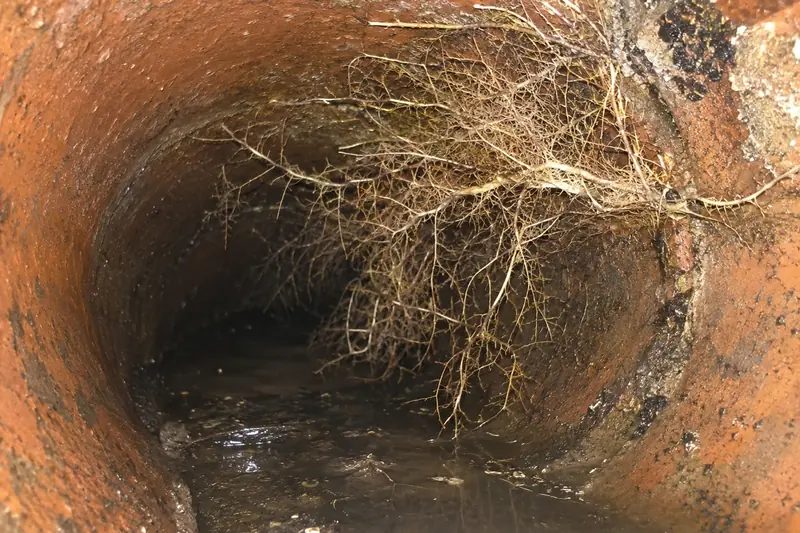
Roots usually follow a leak. They rarely start one on their own. A Riverside public works brochure says a properly installed and maintained lateral will not typically let roots in, but that joints fail or pipe cracks with age and nearby roots then seek the moist soil.
Lakewood, another Southern California city, puts it the same way: roots enter a pipe that has cracked or leaked with age. Neither city is L.A., but the mechanism does not change at a city line. An old clay lateral with tired joints is the usual place it happens.
So a root in the pipe tells you two things: there is a root, and there is an opening. Clearing the first does nothing for the second.
Is ficus worse than jacaranda for sewer pipes?
Nobody has published a ranking this paper can rely on. San Francisco Public Works stopped allowing ficus as a new street tree in the late 1990s, citing sidewalk and other infrastructure damage from roots along with limb failures, but its page does not single out sewer laterals.
For jacaranda we found less. It appears on the City's approved street tree list as reprinted by TreePeople, and no official source we found rates its roots against pipes. Pasadena's house sewer page lists plants especially hard on sewers, including poplar, willow, elm, ash, sycamore and maple. Neither ficus nor jacaranda is named there, which does not clear them.
| Tree | What we could confirm | What we could not |
|---|---|---|
| Ficus microcarpa | Sidewalk and infrastructure damage from roots; about 9 percent of L.A. street trees in a 2008 report | A measured rate of sewer damage |
| Jacaranda | On the City's approved list, via TreePeople | Any official rating of its roots against pipes |
| Poplar, willow, elm, ash, sycamore, maple | Named as hard on sewers by Pasadena | L.A.-specific numbers |
In practice, distance and the pipe's condition count for more than the species, and a camera shows the condition.
Who pays for street tree roots in a lateral?
In the City of Los Angeles, you do. The engineering manual puts root-obstructed laterals on the owner wherever the blockage sits, and LASAN's sewer FAQ agrees. The lateral story has the rest.
A City Attorney opinion puts repair and associated tree costs at the owner's expense too. Other cities can differ: Burbank has a limited payback for lines its own parkway trees have damaged.
What do you have to do before cutting a street tree root?
Get a permit first, and ask before the work is scheduled. StreetsLA Urban Forestry Division requires a permit to trim branches or roots or remove a street tree. Root pruning by the owner goes through a no-fee permit from that division, and it helps owners get permits when a sewer problem involves a street tree.
The City does not root prune parkway trees as an interim measure. Removal is less clear-cut, so ask the division what its current criteria are before assuming a tree can go.
- Get a licensed plumber or sewer contractor to film the line, and keep the video.
- Ask where the roots enter, and whether that is under the parkway.
- Contact Urban Forestry Division with the address and findings before anyone cuts.
- Have the permit in hand before pruning, and let the licensed contractor do the digging.
Do not cut roots in the parkway yourself, and do not trench there. Roots help hold up a large tree: the same Globe report describes an Anaheim case in which a family alleged that root pruning made a ficus unstable before it fell. Utility lines also run through parkways.
What can actually be done about it?
Clearing buys time, and only a repair closes the opening. Pasadena says a root cutting machine is the usual way to clear a root blockage, and suggests cleaning and inspecting a house sewer annually. How often yours needs it depends on the pipe, so let the video guide you.
The choices usually come down to these, and a licensed contractor should explain which fits:
- Clear the line and re-film it, then watch it on a schedule.
- Repair the bad joint or section, with a permit.
- Replace or line the lateral where the City allows, under permit, with inspection in the right-of-way.
LA Sanitation's rebates can help with the video and the repair. Lakewood mentions commercial root-slowing products, but we have no L.A. guidance on them, so ask before pouring anything down a line.
If roots have already caused a backup, leave any cleanout shut while the line is full. Keep clear of the water and phone a licensed plumber.
What this means by age of house
- Before 1930Often clay joints and a very old route. Trees may have been replaced since, so roots can come from an unexpected direction.
- 1930s–1940sClay under mature street trees is a common pairing here; see the 1930s and 1940s page.
- 1950s–1960sTract houses and ficus planted around the same time, per the Globe report. The tree and the pipe have aged together.
- 1970s and newerPlastic pipe has fewer joints to leak, if the lateral was actually replaced. An old connection may remain beyond the property line.
Who handles this
- CSLBIs your contractor licensed?
- LA SanitationMains, plus lateral rebates
- Bureau of EngineeringHouse lateral permits
- StreetsLA Urban Forestry DivisionPermits to prune or remove street trees and their roots
Questions that come up
The tree is on City land. Does that shift the bill?
In the City of Los Angeles, the policy says no. This paper is not a lawyer, so get legal advice if you want to test that.
Would the City take out a tree over this?
Do not plan on it. Removal goes through Urban Forestry Division, and the criteria were unclear in the sources we read. Lakewood says flatly that it will not remove a healthy tree just for this.
Where should a new tree go?
Pasadena suggests keeping trees and shrubs off and away from your house sewer. Find the route before planting, and see free trees through LADWP.
Is a repaired pipe safe from roots for good?
No source we read promises that. Tight joints give roots less way in, so film it again if trouble returns.
What this was checked against
- Street tree trimming and root permits: StreetsLA Urban Forestry Division
- How roots enter a lateral: Riverside wastewater division
- Tree roots affecting sewer lines: City of Lakewood
- Ficus trees and street planting: San Francisco Public Works
- Ficus in Los Angeles, 2008 news report: The Boston Globe
- Plants hard on sewers: City of Pasadena
Sources read in November 2026. Rules and prices change: check the agency before you act.