1930s–1940s
Built in the 1930s and 1940s: the small houses that filled the basin
A 1940s house in Los Angeles often has galvanized water lines, perhaps early copper, cast iron drains and a clay lateral under an old street tree, and it may be smaller and more modest than you'd guess.
From the Plumbing Across L.A. desk. Updated .
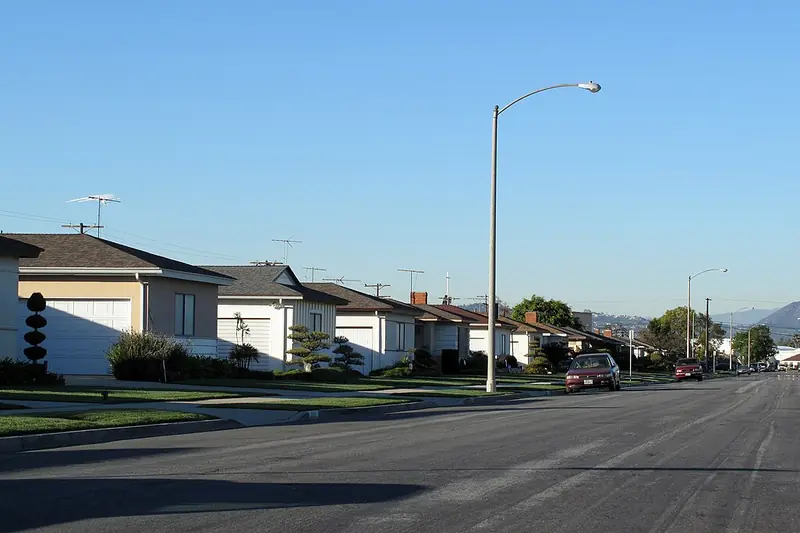
These were the years of slow building, then a defense rush, then a housing shortage. The result across the basin was the small house, built quickly, in large numbers, with fixtures to match.
What went up across L.A. in these years
Building slowed with the Depression, picked up before the war and surged after it. Burbank's context report describes modest Minimal Traditional and "Ranchette" homes built around 1939 to 1945 for Lockheed workers, single-family and multi-family, filling much of the southwest of the city. It's one city's record, but the type spread widely.
After the war, the shortage shaped everything. The LA Conservancy's history of Panorama City describes a late-1940s master plan of over 4,000 houses, many Minimal Traditional, with 3,000 prefabricated in Kaiser's shops. In Brentwood, a 1946 cooperative formed because of the same shortage. There were higher-end versions too: Cliff May's Riviera Ranch of 1939 in Pacific Palisades and the Mar Vista Tract, finished in 1948.
What the pipes usually were
Water lines in this era were often galvanized, which East Bay MUD says was common before the 1960s. Copper was available, as the Copper Development Association's 1927 records show, and may appear in better-built houses or later repairs, so you may find both meeting in one wall. LADWP's FAQ links some copper corrosion to a mixture of pipe materials.
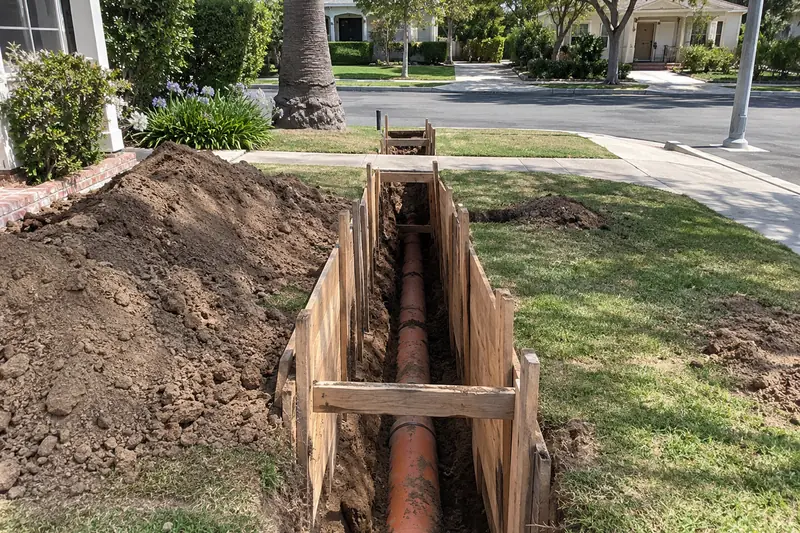
Drains were commonly cast iron, and clay out to the street. Trees planted since have had decades to find the joints. All of this is general. The building year is a clue, not proof, since any owner may have re-plumbed since. See galvanized pipe and ficus and jacaranda roots.
What to check first this year
- Open a faucet with the aerator removed and look for rust flakes or weak flow, and clean the screen. LADWP says brown or orange particles from rusted steel are not a health concern, but they clog screens and aerators. Lead is a separate question in pipe this old: see lead and your tap.
- Note what's visible at the water heater, under sinks and at the hose bibs. Copper and galvanized meeting without a proper fitting is worth a plumber's look.
- If a sewer line backs up, stay out of the water and leave the cleanout closed. Call a licensed plumber.
- If you own in the City of Los Angeles, read who owns your sewer lateral before a street tree makes it urgent, and ask StreetsLA's Urban Forestry Division before anyone touches parkway roots.
- If you plan to sell, start early on the plumbing paperwork and the seismic valve.
Which jobs are licensed
Replacing galvanized lines, working on a sewer lateral and installing a gas valve all belong with a licensed contractor. LADBS permits apply in the City of Los Angeles; other cities run their own. Repiping an L.A. house walks through what to ask before signing.
By part of town
- The Valley Late-1940s tracts led by Panorama City.
- Pasadena, Glendale, Burbank Lockheed-era houses in southwest Burbank; Glendale's Royal Boulevard runs from 1926 to 1948.
- Westside & Beach Riviera Ranch and the Mar Vista Tract at the high end of the era.
- South L.A. & Inglewood Leimert Park filled in after its 1928 start; block-level dates vary.
- Hills & Eastside Infill among older houses, some Modernist in Silver Lake.
- Long Beach & Harbor Bluff Park's period runs through 1949, among older blocks.
Questions that come up
Is a Minimal Traditional house built with cheap plumbing?
Nobody has data on that. These were modest houses with fixtures to match, and the bigger question now is what eighty years of repairs have left.
How can an owner tell galvanized from copper?
Galvanized is usually gray and threaded at joints, copper is reddish-brown and soldered. A licensed plumber can confirm it; no cutting or sanding to find out.
Does a 1940s house need a seismic gas valve?
Age isn't the trigger. In the City of Los Angeles, a sale or certain permitted work is. Other cities have their own rules.
What this was checked against
- Wartime housing in Burbank: City of Burbank
- Panorama City, Mar Vista Tract: Conservancy listings
- Galvanized pipe period: East Bay MUD lead pages
- Brown water and mixed pipe: LADWP FAQ page
- Lateral ownership: City of Los Angeles handout
Sources read in November 2026. Rules and prices change: check the agency before you act.