Lead at an L.A. tap: the street is not where to look
LADWP says there are no lead service lines in its system, including customer-owned ones. If lead reaches your glass, the likely sources are faucets and old solder inside the house, and only a test can tell you.
From the Plumbing Across L.A. desk. Updated .
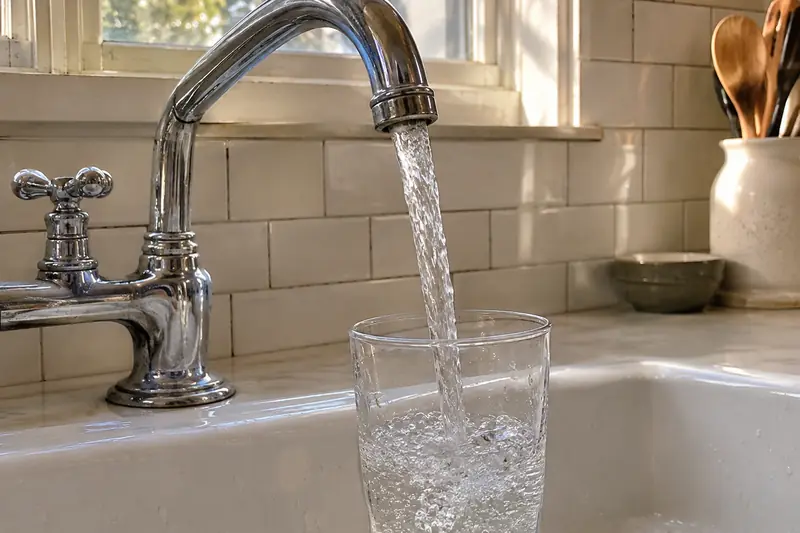
Lead can cause serious health problems, especially for pregnant women and young children, LADWP's drinking water report says. You can't see, taste or smell it in water. So the useful questions are where it could come from in your house and what to do about the water you drink.
This page uses LADWP's figures. Santa Monica, Inglewood, Burbank, Pasadena, Glendale and Long Beach run their own systems. Ask your utility for its inventory; Pasadena's report, for instance, says it is deemed a non-lead service line system.
Does LADWP have any lead service lines?
LADWP says no. Its inventory, completed in October 2024, found no lead service lines or galvanized lines requiring replacement, including customer-owned lines. It inspected 41,813 customer-side lines and verified them as non-lead, and the State Water Board gave it a non-lead designation.
Earlier work backs that up. LADWP reports removing about 12,000 known lead goosenecks by 2005, and replacing more than 607,000 of its roughly 700,000 meters with lead-free ones by December 2025.
Those are the utility's own statements, and the inventory has a clear limit: it stops at the service line. It says nothing about the faucet, solder or pipes inside your house. LADWP says as much, noting that it can't control the materials in your plumbing.
Where does lead in tap water come from in an L.A. house?
Mostly from inside. LADWP's FAQ calls your faucet the most common source. Some older faucets used alloys with a significant amount of lead. When water sits for several hours, lead can dissolve into it, and the first 20 or 30 seconds out of the tap may contain lead.
Copper pipes joined with lead-based solder are the second source. LADWP says this should not be significant if your home was built after 1990, because lead solders were banned in 1986. California's public health department adds a third possibility: old, rusty galvanized pipe, since making it can include small amounts of lead.
- 90th percentile, lead3.9 ppb
- Action level, lead15 ppb
Source: LADWP 2026 water report
What do LADWP's tap tests show?
In 2023 LADWP took 105 first-draw samples from single-family homes built from 1982 to 1987 with original plumbing, which are expected to have copper pipe with lead solder. The 90th percentile was 3.9 ppb for lead and 529 ppb for copper, against action levels of 15 ppb and 1,300 ppb.
That's a good result for that group. It is not a measurement of your faucet, or of a 1925 house with brass fixtures and galvanized pipe. A next round was scheduled for summer 2026; look for its results in a later report.
How do you lower lead at the tap?
The steps below come from LADWP and EPA. None of them requires touching a pipe.
- Use cold water for drinking, cooking and baby formula. Boiling doesn't remove lead.
- Flush the tap for 1 to 2 minutes before drinking from it when water has been sitting. A shower, laundry or a load of dishes all count toward that.
- Clean the faucet's aerator regularly, since lead particles can collect in the screen.
- If you use a filter, choose one certified to remove lead. LADWP names NSF-53 at the point of use. Replace cartridges on schedule and don't run hot water through it.
- Test if you want to know. EPA says testing is the only sure way to tell.
How do you test for lead in L.A. tap water?
Use a certified lab and follow its sampling directions. LADWP says a test usually costs about $50 at a private lab; EPA's broader range is $20 to $100. LADWP's report lists its Water Quality Hotline for questions on testing.
Softeners matter here. LADWP says softened water can be more corrosive to plumbing, and that can push lead and copper higher. Read hard water by neighborhood before adding one to an old system. If a sample comes back high, and a faucet swap doesn't settle it, a repipe is one option for a plumber to weigh.
What this means by age of house
- Before 1930Faucets, solder and galvanized pipe may all be part of the picture. Flush, use cold water and consider a test. See before 1930.
- 1930s–1940sOld brass fixtures and galvanized pipe are common suspects, though any house may have been re-plumbed. A test tells you more than the year does.
- 1950s–1960sCDPH says houses of the 1960s and earlier often have galvanized pipes, and copper from these years may have lead solder. Testing is reasonable.
- 1970s and newerHouses before 1990 may have lead solder, and LADWP sampled 1982–87 houses for that reason. See 1970s and newer. After 1990, the faucet is the first question.
Questions that come up
Is there lead in the water LADWP delivers?
LADWP says no, and that it finds no detectable lead in its sources or distribution system. The concern it describes is what water picks up after that, inside the house.
Will boiling help?
No. EPA says boiling does not remove lead.
Is hot tap water fine for cooking if it gets boiled anyway?
Use cold water for cooking and formula. EPA and LADWP both say so.
A house built in 1995: is that the end of it?
LADWP says solder should not be significant in a home built after 1990. Older faucets may still have been installed later, so a test is the way to be sure.
Does the service line need replacing?
If you're on LADWP, its inventory reports no lead or galvanized lines needing replacement. Don't work on it yourself. Other utilities have their own inventories, so ask yours.
Who handles this
- LADWPIts inventory, water testing and the tap sampling program
- State Water Resources Control BoardAccredited water testing labs
- California Department of Public HealthExposure questions, including children
- EPANational guidance on lead in drinking water
What this was checked against
- 2026 water report, sampling and meters: LADWP report page
- Service line inventory, 41,813 lines inspected: LADWP, utility site
- Faucets, solder and the $50 test: LADWP questions page
- Cold water, aerators, certified filters: EPA, federal site
- Galvanized pipes and lead in older California houses: State public health department
- Non-lead service line status, 2025 report: City of Pasadena's utility
Sources read in November 2026. Rules and prices change: check the agency before you act.