Galvanized pipe in an old L.A. house
Galvanized pipe in an old Los Angeles house is zinc-coated steel that corrodes from the inside. It is often found in houses from the 1960s and earlier, and LADWP says scale can't practically be removed once it builds up.
From the Plumbing Across L.A. desk. Updated .
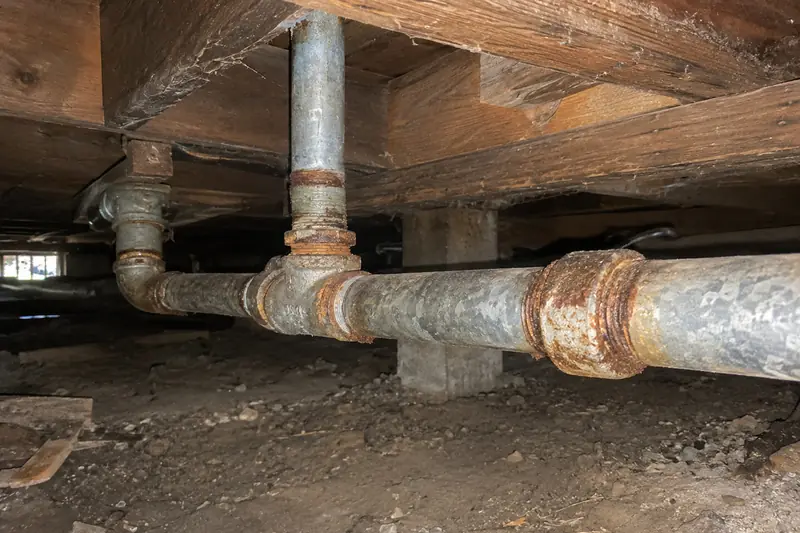
The trouble tends to come on slowly. Pressure drops at one shower, then at the washing machine, and aerators clog with grit. As LADWP explains it, galvanized steel pipes corrode over time and swell on the inside, and built-up minerals flake off into your water.
California's public health department says houses built during the 1960s and earlier often have galvanized water pipes. That is a clue, not a finding. Any house can have been re-plumbed, in whole or in part, at any time. Parts of Hills & Eastside and South L.A. have many houses of those ages.
How can you tell if an old house has galvanized pipe?
Look at exposed pipe and try a strong magnet. CDPH describes galvanized as a dull, silver-grey color and says strong magnets will usually cling to it. Copper has a reddish-brown look, and a magnet shouldn't hold to it. Plastic is plastic.
Good places to look are where pipe is exposed: at the water heater, under sinks, in a crawlspace or basement if one is easy and safe to enter, and at the point where the supply enters the house. Screwed, threaded joints are another hint. What you see at one spot may not hold for the rest of the house, because partial repipes are common. Chrome-plated stubs under a sink can also hide what's behind the wall.
Don't scratch, cut or sand old pipe to find out. If you can't tell, ask a licensed plumber.
| What you notice | What it often means | Next step |
|---|---|---|
| Low pressure at several fixtures | Narrowed old pipe, or another cause such as a valve | Have a plumber check |
| Grit in aerators | Scale or rust from pipes, or heater deposits | Clean the screen; see if it comes back |
| Brown or orange water with clear front-faucet water | Rust from your own plumbing | Consult a plumber |
| Brown water at the front faucet too | Possibly the water main | Report it to your water utility |
What does brown water from galvanized pipe mean?
It usually means rust. LADWP says brown, orange, red and yellow water all come from iron rust, from either its main or your plumbing. It offers a simple check: fill a large white container from the hose faucet at the front of the property after running it wide open for a full two minutes.
If that water is clear, the cause is probably your plumbing, and LADWP says to consult a plumber. If it is discolored, the problem may be the main, so contact LADWP. Note its own caveat: in parts of the Westside, notably Venice, mains can sit at the rear of the property in the alley. Don't use hot water while a main is disturbed, because it can draw rusty water into the tank.
LADWP says rust particles and pipe scale are not a health concern but can clog screens and aerators. The lead question below is a separate one.
Does galvanized pipe raise a lead question?
It can. CDPH says making galvanized pipe can include small amounts of lead, and that when the pipes get old and rusty, the lead can get into the drinking water. Michigan's environment agency says older galvanized coatings had 0.5 to 1.4 percent lead, and a DC Water study found in-home galvanized may contribute lead. Those last two are not Los Angeles sources, and neither measured your pipes.
LADWP's service line inventory reported neither lead lines nor galvanized ones needing replacement. It covers service lines, not pipes inside your house. If you're concerned, test at a certified lab and use the steps in lead and your tap.
When should you plan to replace galvanized pipe?
Plan when symptoms recur in more than one place, or if you're opening walls anyway. LADWP says there is no practical way to remove pipe scale from inside a pipe, and that if the problem is severe you may want to consider re-piping.
Plan the job before a leak forces it. Read repiping an L.A. house for permits, materials and how to compare bids. This paper prints no repipe prices, because we have no sourced figure.
Be careful with softeners too. LADWP says softening water in older plumbing can cause deposited minerals to break loose, and that softened water can be more corrosive. Read hard water by neighborhood before you add one to an old system.
On your street
- Hills & Eastside Steep lots and older houses can mean long, hard-to-reach pipe runs, so ask a plumber how they would reach them.
- South L.A. & Inglewood Inglewood has its own water utility, so its notices and reports are different from LADWP's.
- Westside & Beach In parts of Venice the main can be in the alley behind the house, which changes where the supply comes in.
What this means by age of house
- Before 1930Galvanized is a real possibility unless the house has been re-plumbed. Some have been, in part. See before 1930.
- 1930s–1940sGalvanized is still common to expect in original pipe, often mixed with later copper. See the 1930s and 1940s.
- 1950s–1960sCDPH's "1960s and earlier" covers this period, though copper was also in use, so check rather than assume.
- 1970s and newerLess likely as original supply pipe, though a repair or addition can leave a surprise. A magnet check still costs nothing.
Questions that come up
Would replacing only the worst section work?
Often that's possible, and it may help for a while. Ask the plumber what happens at the joints where old pipe meets new, and what remains upstream.
Why is only one faucet weak?
It may be a clogged aerator or valve rather than the whole line. Clean the screen and see. Several weak fixtures point more toward the pipe.
Can chemicals or a descaling treatment clear galvanized pipe?
LADWP says there is no practical way to remove pipe scale from inside your pipes. Treat that kind of claim with suspicion and ask for evidence in writing.
Did LADWP's inventory check the pipes in my walls?
No. It covers service lines, including customer-owned ones. Plumbing inside the house is yours to check.
Who handles this
- LADWPRusty water from a main and quality complaints where it serves
- LADBSRepipe permits inside the city
- CSLBThe license lookup before you hire anyone
- California Department of Public HealthState advice on lead and older plumbing
What this was checked against
- Rusty water, pipe scale and the front-faucet check: LADWP water pages
- Lead service line replacement and galvanized note: California Department of Public Health
- Galvanized service lines: Michigan EGLE
- Lead levels study: DC Water
Sources read in November 2026. Rules and prices change: check the agency before you act.