Neighborhood edition
The Valley: ranch houses on slabs and long hot summers
San Fernando Valley plumbing is mostly a postwar story: ranch houses, often on slabs, on LADWP water, with water heaters in hot garages and summer bills that follow lot size.
From the Plumbing Across L.A. desk. Updated .
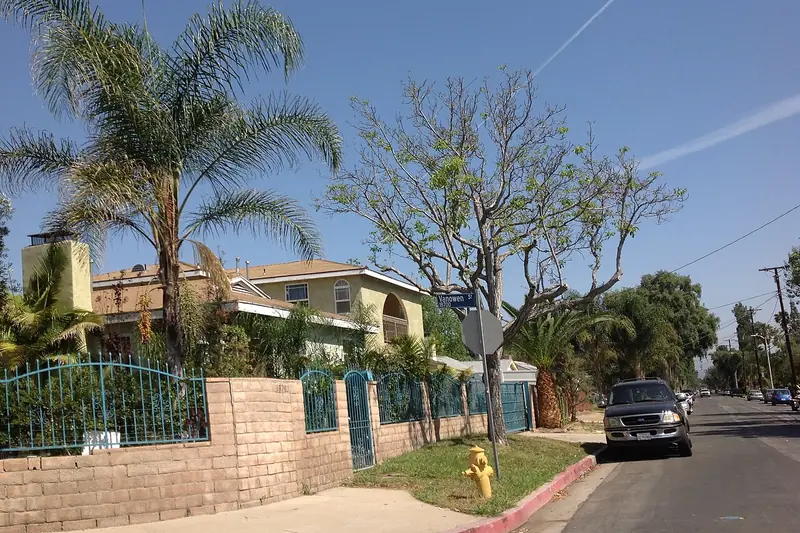
The Valley was, in the LA Conservancy's phrase, a blank canvas for Ranch houses after World War II. That shared age means shared questions, even where a street looks nothing like the next one over.
Who supplies your water here
LADWP supplies nearly all of it, and its report calls the area San Fernando Valley, from Sylmar and Sunland to Woodland Hills and Studio City. It also lists the Hollywood Hills here. Burbank is a separate city with its own utility and has its own edition; San Fernando, Glendale and the rest of the ring are not on this list either.
Water here is a blend of the Los Angeles Aqueduct, local groundwater and State Water Project supply. In 2025 the three sources LADWP lists tested at 6.0 grains per gallon (aqueduct plant), 6.7 (Northern Combined Wells, ranging from 78 to 151 mg/L) and 8.2 (Jensen). On LADWP's scale, 7 grains is the line between medium-hard and hard, so you can land on either side of it depending on the month. Hard water by neighborhood has the table.
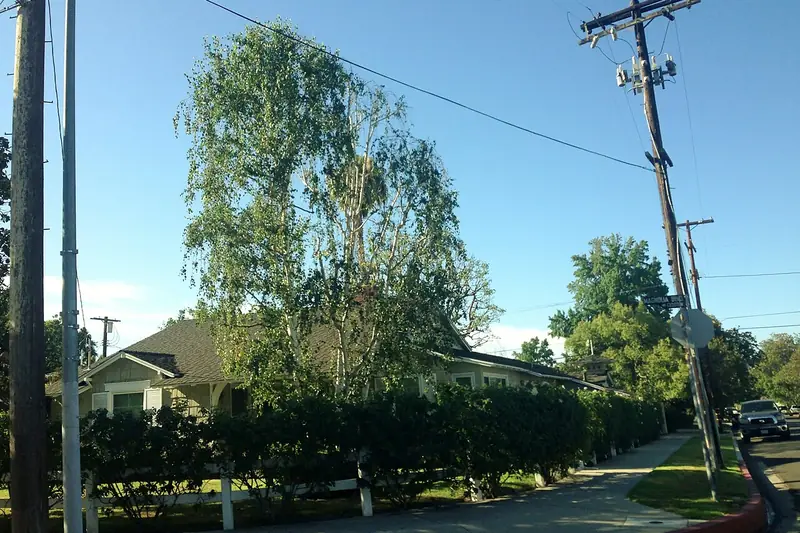
What kind of houses are here
Many date from the late 1940s through the 1950s. Panorama City, built for Kaiser in the late 1940s, had a master plan for over 4,000 houses, mostly Ranch and Minimal Traditional. The Conservancy dates four Ranch neighborhoods here to between 1955 and 1959, including Westridge Park, whose one-story houses went up in 1957 and 1958 on quarter-acre lots.
Not everything is postwar. Van Nuys was founded in 1911 and annexed in 1915, so it holds older houses too. A tract house may also have been re-plumbed since, so use the decade as a first guess: the 1950s and 1960s for most, the 1930s and 1940s for older blocks.
What tends to go wrong here
This is what the house type points toward. No agency publishes a count by neighborhood.
- Leaks under the floor. Water lines in a slab house may run in or under the concrete, so a leak can hide for a long time. Slab leaks in Valley ranch houses covers the signs, and the high-bill leak check comes first.
- Heat. Water heaters and pipes in garages and attics get hot in summer. Don't go up in a heat wave; attics and crawlspaces says what can wait until a cool morning.
- Earthquake straps. State law requires bracing on a residential water heater, and a garage heater is no exception: see water heater straps.
- Roots. Mature street trees and older laterals meet here too, with roots in the sewer line one common outcome.
Why your lot size matters on the bill
LADWP sizes its outdoor tiers by lot, and a big Valley lot gets more water before the higher rates start. A quarter acre is 10,890 square feet (our arithmetic), which falls in the 7,500 to 10,999 band: from June through September, that band's bimonthly blocks are 16, 24 and 48 HCF, with Tier 4 over 88. A lot under 7,500 square feet reaches Tier 4 over 70. Reading an LADWP water bill explains the rest, and watering days has the schedule.
Neighborhood stops
- Van NuysOlder than the tracts around it.
- Panorama CityMaster-planned for Kaiser.
- ResedaTraditional Ranch tracts.
- NorthridgeSome large custom Ranch lots.
- Canoga ParkQuarter-acre lots at Westridge Park.
- Studio CitySlopes behave differently from flats.
Who handles this
- LADWPYour water, your tiers and the rebates
- LA SanitationValley mains, and rebates for your lateral
- CSLBConfirms a license is current
- LADBSPermits, water heater replacement among them
Questions that come up
How can an owner tell if a Valley house is on a slab?
Many postwar houses of this type are, but not all, and this paper knows of no count. Walk the outside: foundation vents usually mean a crawlspace, and none suggests a slab. A permit record or a licensed plumber can confirm it.
Does Valley water need softening?
LADWP's position is that none of its water needs softening for safety or everyday use. It treats softening as your choice and warns that softened water may corrode pipes faster.
Why does LADWP list the Hollywood Hills with the Valley?
LADWP's report lists the Hollywood Hills in its San Fernando Valley area. It doesn't give a reason.
What this was checked against
- Valley sources, 2025: LADWP report
- Four Ranch subdivisions: LA Conservancy
- Panorama City: LA Conservancy
- Westridge Park: LA Conservancy
- Van Nuys dates: CSUN University Library
- Summer tier blocks: LADWP Schedule A
Sources read in November 2026. Rules and prices change: check the agency before you act.