Bungalow courts and duplexes: when the pipes are shared
Bungalow court plumbing in Los Angeles is often shared: one lot, one sewer lateral, sometimes one water meter. So one clog or shutoff can reach every unit, and the lot's owner usually carries the repair.
From the Plumbing Across L.A. desk. Updated .
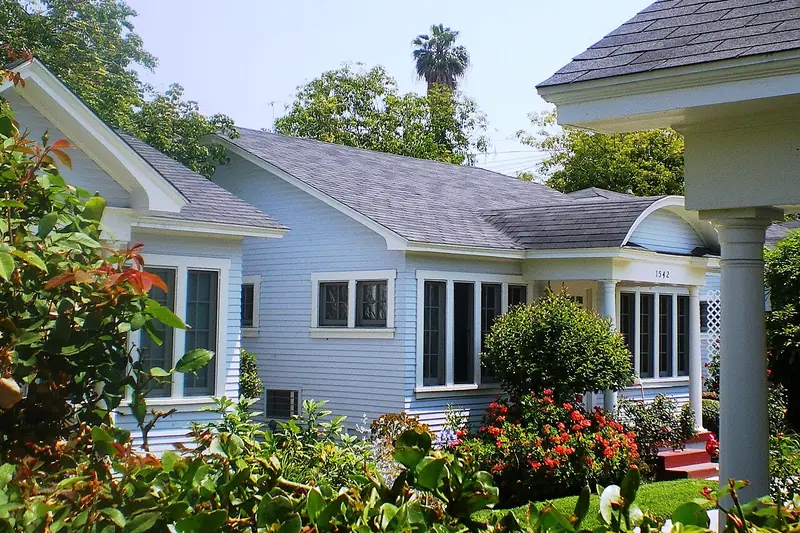
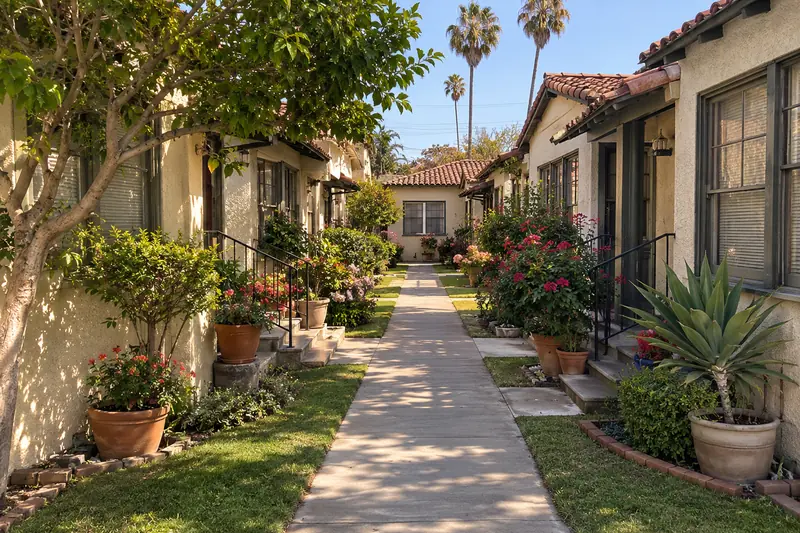
The form is older than most of the pipes in it. Pasadena's planning department dates its courts from 1909 through 1942 and counted 112 in a 2010 survey: one-story houses or duplexes around a shared courtyard, usually on a single property.
That last phrase is the plumbing story. A row of small front doors can look like a street of separate houses, but below the walkway it may be one building's worth of pipe.
Why does bungalow court plumbing get shared?
Because a court is usually one property, and sewer rules follow the lot. LA Sanitation says a lateral serves one lot, so several cottages on one lot may drain through a single connection to the main. The layout cannot be read from outside, and it may have changed over a century.
The City's reconnection handout also says new reconnections generally may not share a lateral. Older arrangements can still exist, and L.A.'s engineering manual has a definition for a shared house connection with limits in the municipal code. If your lot appears to share with a neighboring lot, ask the Bureau of Engineering before anyone digs.
Who pays when a shared lateral clogs?
Usually the owner of the lot, because the City of Los Angeles puts the lateral on the property owner, all the way to the main. What changes is who that owner is.
| Your situation | Where to start |
|---|---|
| You rent a unit | Tell the landlord in writing. Civil Code 1941.1 covers working plumbing and a sewer connection |
| You own the whole court or duplex | The bill and the permit are yours |
| You own one unit in a condo-style court | Read the CC&Rs and ask the association who owns the line |
| Your lot shares with a neighboring lot | Find any recorded agreement, then ask the Bureau of Engineering |
California's Civil Code 1941.1 lists plumbing kept in good working order, and a water system connected to an approved sewage disposal system, among the things a rental must not substantially lack. This paper is not a lawyer, so take a dispute to a housing agency or a tenant lawyer.
A clog that hits three cottages and spares the fourth is useful information, because it hints at where the branches join. Tell the plumber which units were affected and in what order, and ask for camera video.
If a line has backed up, nobody should open a cleanout to relieve it, and nobody should wade through it. Use no water anywhere on the shared line until a licensed plumber has cleared it, and warn the neighbors, since their sink may be what fills your tub.
Where are the water shutoffs in a court or duplex?
Start with the meter and work inward. LADWP's water FAQ calls the main shutoff the wheel valve, and places it by the faucet nearest the meter, often out front. Parts of the Westside, Venice among them, have mains in the alley behind, so look back there too.
A court may also have branch valves, or may have none. Walk the property on a calm day with the owner or manager, and write down what each valve controls.
- Find the meter and the wheel valve, and note which units go dry when it closes. Warn everyone first.
- Look for valves at each cottage, often where the pipe enters or at the back wall.
- Check the small stops under each sink and toilet. Do not force one that will not turn; an old valve can fail open or start to leak.
- Post the map where every household can read it.
Leave gas valves alone on this walk. At any smell of gas, all households get out first, flip no switches, and phone 911 and SoCalGas once outside.
How does a shared meter change the bill?
It makes leaks everyone's problem and nobody's. LADWP keeps single-dwelling Schedule A separate from a multi-dwelling schedule for apartment owners, so check which one your bill shows before comparing it with the tiers we describe elsewhere.
A running toilet in one cottage can look like a high bill for all of them, so ask each household to try the 10-minute tank test on our leak page.
What this means by age of house
- Before 1930Peak court years. Expect a mix of original and patched lines, and valves that may not have been turned in decades.
- 1930s–1940sLater courts and many duplexes. Often galvanized supply lines and clay out to the street; see galvanized pipe.
- 1950s–1960sFewer courts, more small apartment buildings. Shutoffs may be easier to find, but ask about any line under a slab.
- 1970s and newerShared lines are still possible, though association documents are more likely to spell out who owns what.
On your street
- Hills & Eastside Older duplexes and small courts are worth checking; the Hills & Eastside edition covers LADWP and steep-lot issues.
- Pasadena, Glendale, Burbank Pasadena has its own water utility and its own house sewer rule, so the L.A. City answer above does not carry over. See that edition.
What should you ask before buying or renting a court unit?
Ask how the pipes are divided before you ask how they look. A real estate listing rarely says.
- How many water meters serve the property, and which units are on each?
- Is there one sewer lateral, and has it been on camera?
- Who pays a shared repair, in which document?
- Where are the shutoffs, and has anyone tested them?
- Has the property changed lots or ownership form since it was built?
For a court on a historic list, also ask the city before altering anything visible, since the route of a repair may matter.
Who handles this
- LADWPMeters, and which rate schedule you are on
- L.A. Bureau of EngineeringSewer maps, plus shared-connection questions
- LA SanitationLateral rebates and main problems inside City limits
- Pasadena Water and PowerWater for courts inside Pasadena
Questions that come up
Whose bill is a clog one tenant caused?
This depends on the lease and on what caused the clog. Ask the owner in writing, and ask a tenant lawyer or housing agency if it turns into a dispute.
Are old shared laterals illegal?
The handout speaks to new reconnections, which is not the same as calling every old arrangement unlawful. Ask the Bureau of Engineering about yours.
Is splitting a duplex onto two meters possible?
Possibly, but this paper has not confirmed the LADWP steps. Ask LADWP and a licensed plumber before planning on it.
Do courts with several units get the rebate?
Multifamily property is on LA Sanitation's list. Confirm your property fits and that money remains.
What this was checked against
- Courts from 1909 to 1942, and the 2010 survey count: City of Pasadena Planning
- One lateral to one lot: LA Sanitation
- New reconnections and shared laterals: City recovery office
- Wheel valve and alley mains: LADWP
Sources read in November 2026. Rules and prices change: check the agency before you act.