Who owns the sewer pipe under the street? In L.A., you do
Who is responsible for a sewer lateral in Los Angeles? In the City of Los Angeles, the property owner is, from the house all the way to the main under the street, including under the public right-of-way.
From the Plumbing Across L.A. desk. Updated .
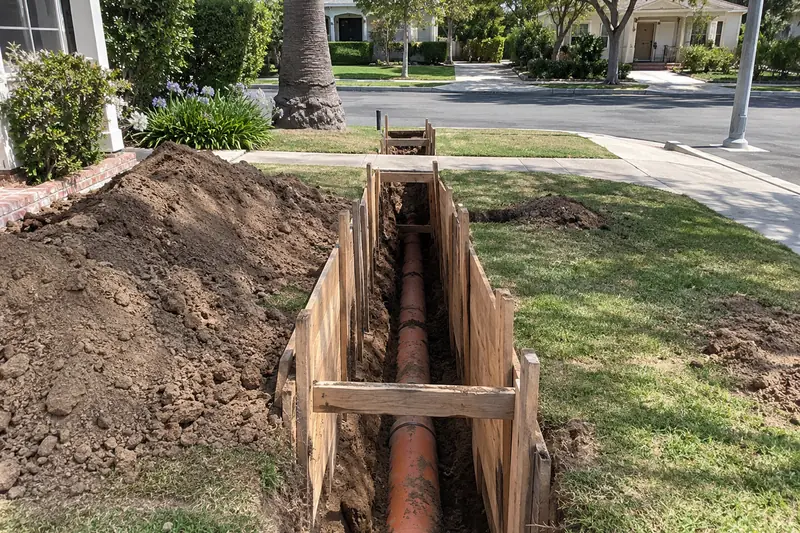
Most owners find this out on the worst day possible. The pipe under the sidewalk and asphalt looks public, sits on public land, and is yours to maintain anyway.
The word to learn is lateral, which City documents also call a house connection, or HC. The S-Permit handout defines it as the pipe that takes wastewater from your property to the City sewer main in the street.
Who is responsible for a sewer lateral in Los Angeles, exactly?
You are, for the whole length. The same handout says the owner's duty includes the part in the public right-of-way, between the property line and the connection to the main.
The City's engineering permit manual calls this a long-standing policy based on the opinion of the City Attorney. Roots are no exception, whichever side of the property line they turn up on. Ficus and jacaranda roots goes through that part.
The City's job is the main. Everything from your house up to that connection is on you.
| Piece of pipe | Where it runs | Who maintains it |
|---|---|---|
| Interior drains | Inside the house | Owner |
| Building sewer | House to property line | Owner |
| House connection (lateral) | Property line to the main | Owner |
| Mainline sewer | Usually mid-street | City |
What does owning the lateral mean in practice?
It means the bill, the permit and the risk are all yours. A repair in the street is also a street job, so more parties get involved than for a repair in your yard.
- Permit: the manual says fixing a damaged HC calls for a Sewer Connection Permit, or S-Permit.
- Contractor: in the public right-of-way the permit must come from an approved Bonded Sewer Contractor, whose approval lasts one year. A plumber may pull one for a connection made at the property line.
- Inspection: the Bureau of Contract Administration inspects construction in the right-of-way.
- The road: the handout treats a lateral that could damage the roadway or create sinkholes as one that must be repaired or replaced before reconnection in rebuild cases.
None of this is homeowner work. Do not trench, and do not open a cleanout during a backup, because what is behind it can come out with force. CSLB says four license classes may work on building sewers: C-36 plumbers, plus A, C-42 and C-34.
Does the City help pay for it?
Sometimes, within limits. LA Sanitation runs rebates of up to $300 for video and up to $2,500 for repair, first come, first served until the annual funds run out. One older LASAN FAQ denies any such help, but the rebate pages are newer. Confirm funds with LA Sanitation first.
A homeowner's policy may or may not respond. This paper has not reviewed any policy, so ask your insurer in writing what a sewer line endorsement would cover, and whether it includes the part under the street.
Do other cities treat the sewer lateral the same way?
The common pattern is similar, but the details differ, and the city line matters. The City of Los Angeles answer stops at the city limit. These are the rules we could read as of November 2026.
| Place | What it says |
|---|---|
| Unincorporated L.A. County | Owner maintains laterals, including under the street (County Code 20.24.080) |
| Pasadena | Owner maintains the house sewer past the property line to the City line |
| Long Beach | Owner has the private section; the street section is shared with the City, with routine upkeep of both on the owner |
| Burbank | Owner maintains the lateral, with a limited City reimbursement tied to parkway trees |
| West Hollywood | Owner maintains the lateral, including the connection to the main |
| Glendale, Santa Monica, Inglewood | Not confirmed here. Ask the city's public works department |
Pasadena's house sewer page says the private sewer begins 24 inches from the outside wall and extends beyond the property line. Long Beach Utilities describes two sections, and says the City maintains and restores laterals on city property while routine maintenance of both sections falls to the owner.
Burbank's program is the most distinctive we found: when a city-owned parkway tree has crushed or displaced a lateral, it can pay back part of the repair, up to a limit in its fee schedule. L.A. County says laterals are entirely owned by the private owners they serve, and suggests a backflow preventer and a cleanout. West Hollywood's sewer page puts the connection point on the owner too.
On your street
- Hills & Eastside Largely inside City limits, where the owner-to-the-main rule applies. Steep lots add their own problems; see hillside sewers.
- The Valley Most neighborhoods here are in the City of Los Angeles, so film the line before a big remodel.
- Pasadena, Glendale, Burbank Three cities with three separate answers, and Glendale is unconfirmed here. Read the area edition.
- Westside & Beach Check whether your address is in Santa Monica or Culver City, since each is its own city, before relying on this page.
- South L.A. & Inglewood South L.A. follows the City of Los Angeles rule. Inglewood is a separate city, so ask there.
- Long Beach & Harbor Long Beach has the split described above. San Pedro and Wilmington follow the L.A. rule.
What this means by age of house
- Before 1930Your lateral may be as old as the house, often clay, with a century of street work above it. Find out before you need to.
- 1930s–1940sSame concern, often with street trees now fully grown over the line. Clay and cast iron explains the usual failures.
- 1950s–1960sNewer than a bungalow's, but still well past half a century if it was never replaced. Records may show when it was last touched.
- 1970s and newerThe lateral may be younger plastic, or an old connection reused. A camera answers what the year cannot.
How do you find your lateral and its records?
Ask the City, then a camera. The manual says City sewer maps show whether a lateral from the main is available at a property, and that a dye test can confirm a lot's connection. LA Sanitation can answer questions about the main, and LADBS records may show private-side permits.
Then pay a licensed sewer contractor or plumber to film it and mark the route. The camera story says what to ask for, and the permit notes cover the private side.
Who handles this
- LA SanitationCity mains, and both rebates
- Bureau of Contract AdministrationInspecting right-of-way work
- L.A. Bureau of EngineeringS-Permits, sewer maps and bonded contractor approvals
- Long Beach UtilitiesThe City section of a Long Beach lateral
- L.A. County Public WorksUnincorporated areas and member cities
Questions that come up
The break is under the street. Why would the City not fix it?
In the City of Los Angeles, policy puts the whole lateral on the owner, even the part in the right-of-way. The City's duty starts at the main.
What if the main itself is blocked?
Then it is the City's. Pasadena notes these are rare and hit a whole neighborhood, which is a useful clue. Report it to the sewer agency.
Might two houses share one lateral?
The City's rule is one lot per lateral, and older exceptions are covered in our bungalow court story.
Must a seller have the lateral inspected?
We found no L.A. City rule saying so for ordinary sales. Buyers often ask anyway, and the sale paperwork story covers other items.
Is my lateral 4 inches or 6?
The handout says an existing 4-inch connection in good condition is generally fine for reconnection and need not be upsized for that purpose. A camera or the City's records can tell you the size.
What this was checked against
- Lateral definition and one lot per lateral: Rebuilding L.A. handout
- Owner duty and City Attorney opinion: L.A. Bureau of Engineering
- County Code 20.24.080: L.A. County Public Works
- Municipal Code 13.24.610: City of Pasadena
- Lateral sections and duties: Long Beach Utilities
- Sewer Lateral User Rebate Program: City of Burbank
- Private lateral duties: City of West Hollywood
Sources read in November 2026. Rules and prices change: check the agency before you act.