Hillside houses: pumps, pressure and pipes on a slope
Hillside house plumbing in Los Angeles turns on elevation. A house below the sewer may need a sewage pump, and water pressure changes with ground height. Pump and regulator work is licensed work.
From the Plumbing Across L.A. desk. Updated .
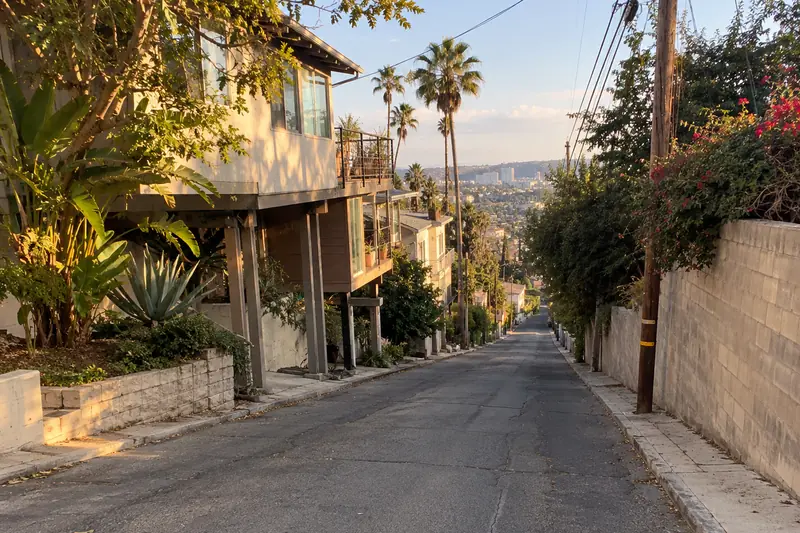
A house on flat ground mostly lets gravity do the job. On a slope, the same plumbing may push water uphill, hold it back, or let it build more pressure than your fixtures were meant to take.
Whether any of this applies to your house is a question for the address, not the neighborhood. Two houses on one curve can be on different sides of the sewer's height.
How does a hillside house below the street get rid of sewage?
Gravity if it can, a pump if it cannot. This paper found no City of Los Angeles page that explains the rule for homeowners, so here is the closest official description, from outside L.A.: Central Contra Costa Sanitary District says that where a residence sits lower than the public sewer, the owner must install a pump to lift sewage up to it, at the owner's cost.
In L.A., LADBS has plan-check sheets for sewage ejectors, which shows these go through plumbing review. The 2025 California Plumbing Code section on ejectors sets pump capacity and discharge piping for a single dwelling, including a backwater valve and a gate valve on the line.
For an individual lot, ask the Bureau of Engineering and LADBS; L.A. also adopts its own version of the state code. The permit manual says a house connection may run in a street, alley or sewer easement, so on a hill the main is not always where you would guess.
What is a backwater valve, and does a hillside house need one?
It is a valve that lets waste out and stops it from flowing back in. The California Plumbing Code section on backflow protection requires one for fixtures on a floor below the next upstream manhole cover, and LADBS's backwater valve sheet says installing one takes a plumbing permit.
A lower floor in a stepped hillside house can fall below that line even when the upper floor does not. Only fixtures below it should run through the valve, which is one reason the layout should be drawn by someone licensed.
A cleanout on a drain with a backwater valve is supposed to carry a permanent label reading "backwater valve downstream." Look for it, leave it closed, and mention it to anyone who services your drains. The county also suggests a backflow preventer and cleanout on a lateral.
Why does hillside house plumbing change the water pressure?
Because pressure follows elevation. LADWP says on its water pressure page that it calculates the maximum and minimum for an address from the ground elevation, and that plumbers and homeowners use the figure to work out pipe needs and whether a regulator is required.
As a general rule, lower on a hill tends to mean more pressure, higher tends to mean less. Zoning of the system matters too, so trust the address lookup over the view from your porch.
| Item | What LADWP says |
|---|---|
| When new residential plumbing needs a regulator | City water main pressure can exceed 80 psi |
| Where the rule comes from | The Uniform Plumbing Code as enforced by LADBS |
| Usual regulator setting | 50 to 70 psi |
| Who installs and maintains it | The property owner |
| Where it sits | Above ground, usually near where plumbing enters the house |
Homes built before the current code may have no regulator, LADWP notes, even with main pressure above 80 psi. That matters on older streets, where a house can predate the rule.
Ask LADWP's Water Distribution Services Section for your address's range. In a neighborhood served by another utility, ask that utility.
How can you tell if the pressure is too high?
Measure it, or have a plumber measure it. San Diego's public utilities department, which is not LADWP, lists the symptoms of a failing regulator: banging or whistling pipes, especially when water shuts off; more flow than expected; and frequent leaks in toilets and faucets.
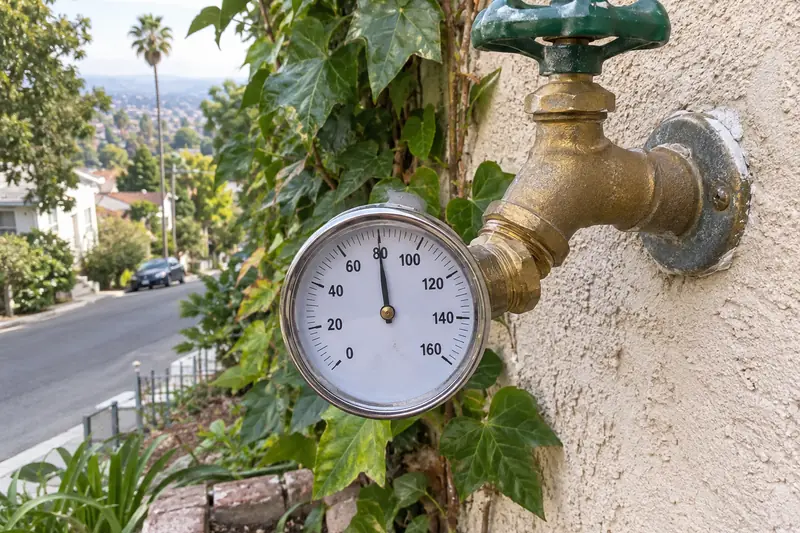
The same guide says a pressure gauge on an outdoor hose faucet is one way to read it, and a plumber can check during other work. Stop there. Adjusting or replacing a regulator is a plumber's job here, and it may need a permit.
High pressure can also make small leaks worse, so read it alongside our high-bill leak check. For low pressure at the top of a hill, ask first whether the main or your own narrowed old pipe is the cause. Rust inside old galvanized can cut flow on any elevation.
What this means by age of house
- Before 1930Steep-lot houses this old may predate both current pressure rules and any pump. Find out what was added later, and by whom.
- 1930s–1940sRegulators are often later additions, if present at all. Old galvanized on a slope can confuse the low-pressure question.
- 1950s–1960sPump or regulator parts may have been replaced piecemeal by now, so ask to see the permit records.
- 1970s and newerMore likely to have a regulator and a documented pump, but equipment wears out. Ask its age and who services it.
What should a hillside buyer or owner ask?
Ask about each moving part, because a flat-lot inspection may skip them. Start with these, and put the answers in writing.
- Is the house on a gravity lateral, a pump or something else? The Bureau of Engineering's maps and dye test can help.
- If there is a pump, how old is it, who services it, and is there an alarm?
- Where does the lateral run, and has it been on camera? The owner maintains it in the City of Los Angeles.
- What is LADWP's pressure range for this address, and is there a regulator?
- Does a retaining wall, slope drain or old septic line touch any of this?
Pasadena's house sewer page notes that some properties still have a cesspool or septic tank, so ask if records are unclear. Trenching on a slope is licensed work, and so is anything touching a retaining wall.
On your street
- Hills & Eastside Hollywood Hills, Mt. Washington, Mt. Olympus and Silver Lake are in LADWP territory, so the pressure lookup applies. The area edition has more.
- Westside & Beach Bel Air Estates, Castellamare and Palisades Highlands are on LADWP's list. After the 2025 fires, check rebuild rules too; see the Westside edition.
- The Valley LADWP lists Sherman Oaks, Studio City, Encino, Tarzana and Woodland Hills in the Valley, and their southern streets can climb. Check the address.
- Pasadena, Glendale, Burbank LADWP's lookup covers only its own customers, so ask your city's utility and public works department.
Who handles this
- LADBSEjector plan check and plumbing permits
- L.A. Bureau of EngineeringSewer maps and dye tests
- CSLBIs the plumber licensed?
- LADWP Water Distribution Services SectionPressure range for an address it serves
Questions that come up
Who owns a private sewage pump?
We found no L.A. page that says. Owners maintain their laterals in the City of Los Angeles, and Central San puts a pump on the owner. Ask LADBS and the Bureau of Engineering about your lot.
How does a sewage pump behave in an outage?
It depends on the equipment, so ask the plumber who services yours. Use as little water as you can until power returns, and do not open the basin.
Is 80 psi a good regulator setting?
LADWP says regulators are usually set between 50 and 70 psi. Leave the setting to a plumber, who can check it against your fixtures.
Does being on a hill mean weak water?
Not necessarily. Ground height is one input, and pressure zones are another. Get the range for your address before spending money on a fix.
What this was checked against
- Water pressure and regulators: LADWP
- Backflow protection, section 710.1, 2025 edition: California Plumbing Code, via Gocodebook
- Ejectors and pumps, section 710.3, 2025 edition: California Plumbing Code, via Gocodebook
- Backwater valve and ejector sheets: LADBS
- Residential sewage pumps, not an L.A. agency: Central Contra Costa Sanitary District
- Pressure reducing valve guidelines, not an L.A. agency: City of San Diego
Sources read in November 2026. Rules and prices change: check the agency before you act.